01 · The math · 8 min
Why pre-leasing has value
The occupancy math, extra rent, and time-to-stabilize — plus how to read the numbers without overclaiming.
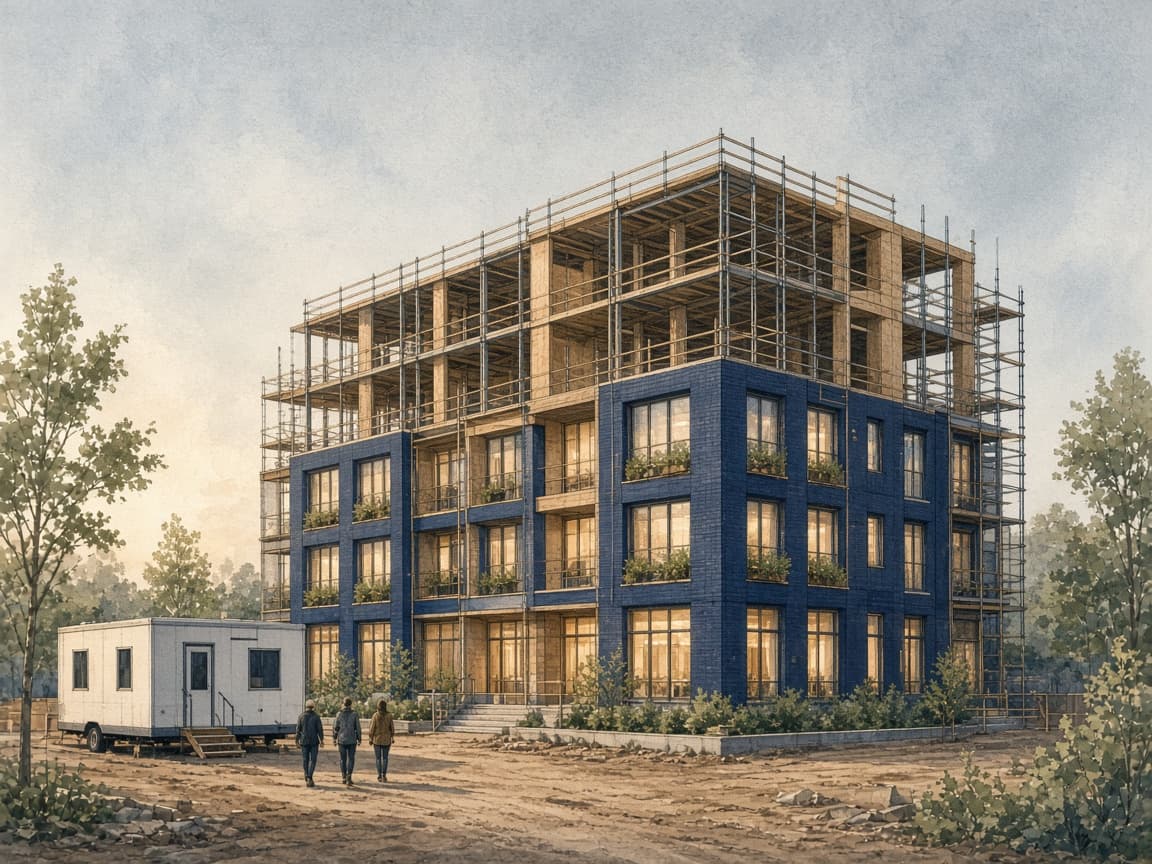
A unit occupied before opening starts paying on day one
Pre-leasing is not a marketing slogan. It is a timing shift. Every unit occupied before the certificate of occupancy begins generating rent the month you open, instead of sitting empty while a leasing team starts from zero.
That gap is the value. If two identical communities lease remaining units at the same pace after opening, the one that already has signed leases is simply ahead on the occupancy curve — and it stays ahead until the other community finally fills.
The cash that difference produces is usually larger than the cost of the pre-leasing program — even when that program is fully staffed. The question is not whether pre-leasing can have value. It is how many units you can occupy early, and which coverage model you pay for to get there.
A simple occupancy model
Hold the community size, rent, and post-opening leasing pace constant. Then compare two starting points:
- Without pre-leasing: units occupied at month t = min(Total, Rate × t)
- With pre-leasing: units occupied = min(Total, Pre-leased + Rate × t)
Extra units occupied in a given month is the difference between those two curves. Extra rent that month is extra units occupied × average rent. Net value after T months is the sum of that extra rent, minus what you spent to pre-lease.
| Quantity | Formula |
|---|---|
| Units occupied with pre-leasing | min(Total, P + R × t) |
| Units occupied without | min(Total, R × t) |
| Extra units occupied | Occupied with − Occupied without |
| Extra rent in month t | Extra units occupied × average rent |
| Net value at month T | Σ extra rent − cost of pre-leasing |
Two results fall out immediately. First, months to stabilize drop from Total / Rate to (Total − P) / Rate. Second, the extra units occupied stay close to P until the pre-leased community is full — then they taper as the community that started at zero catches up.
Worked example: 200 units, 48 occupied at opening
Take a 200-unit community, $1,850 average rent, 10 leases per month after opening, and 48 units already occupied at opening. That is 24% occupied instead of empty.
Units occupied at opening
48 vs 0
24% occupied instead of empty
Months to stabilize
15.2 vs 20
4.8 months faster
Extra units occupied, month 12
48 units
168 occupied vs 120
Extra rent each month
$88,800
48 extra units × $1,850
In this setup the extra units occupied stay at 48 for the entire first year, because the community that started at zero has not filled yet. That is $88,800 of extra rent each month, or $1,065,600 over 12 months — before subtracting program cost.
Typical program costs are much higher than a website alone: about $400,000 for a fully staffed pre-leasing effort, $180,000 for partial staffing, and $20,000 for a more minimal program. Net value still holds in this example:
| Program | Typical cost | Payback | Net value, 12 months |
|---|---|---|---|
| Minimal | $20,000 | Month 1 | $1,045,600 |
| Partial | $180,000 | Month 3 | $885,600 |
| Fully staffed | $400,000 | Month 5 | $665,600 |
Change the inputs and the story changes. Pre-lease fewer units, or assume a much faster walk-in pace after opening, and the gap shrinks. Raise rent or slow absorption, and it grows. A fully staffed program needs more units occupied at opening to justify itself than a minimal one does.
Open the value calculator to plug in your unit count, rent, absorption, and program cost.
Value the formula does not capture
Captured rent is the cleanest number. It is not the only one.
- Construction interest and carry. A shorter lease-up can mean earlier refinance, fewer months of interest-only debt, and less cash sitting in an empty building.
- Concessions. A cold opening often buys occupancy with free months or gift cards. Demand already in hand can protect asking rent.
- Operating drag. Empty floors still need insurance, security, utilities, and a skeleton staff. Occupancy spreads those costs sooner.
- Learning. Inquiry volume, unit mix interest, and price resistance show up before you open — while you can still change finishes, premiums, or marketing.
There are costs on the other side: salaries before revenue, a model or trailer, and the risk of leasing too far ahead of delivery. The calculator nets a single pre-leasing cost against extra rent. Your actual decision should include carry, concessions, and how confident you are in the delivery date.
How to use the numbers
Treat pre-leasing as a return on program spend. If extra first-year rent is large relative to a $20,000–$400,000 budget, the program is worth running — even if you only occupy a slice of the community before opening.
Then choose an operating model that matches how many conversations you can actually handle: fully staffed, partially staffed, or a more minimal / support-only setup. The math tells you the prize. Staffing and marketing decide whether you collect it — or spend it.